October 19, 2026
Tavi
Hire a Content Writer: How to Choose Wisely
You’re looking for a content writer. You’ve probably looked at Fiverr or Upwork, or a similar service. Not all writers are created equal. So, before you pay someone, you need to make sure you’re going to get real value from your money.
When a business has a solid brand and website, but not enough people are finding it, a good SEO content writer can turn the questions your customers type into Google into helpful articles that bring them to your site. The best hire knows search, asks about your business, and uses your real expertise instead of generic filler.
Here’s how to find the best writer for the job.
Key takeaways
- A content writer pays off when the foundation is solid but visibility isn't.
- Cost depends on more than word count. Research, SEO strategy, interviews, editing, and volume all change the price.
- SEO skill and curiosity matter as much as writing skill, and content built on real experience is what stands out.
When does it make sense to hire a content writer?
The best time to hire one is when the brand, landing pages, and website already work, but the leads aren't coming in. That isn't a product problem. It's a visibility problem.
One common analogy compares it to a cute little clothing store in a terrible location. The products are great, but nobody sees them, because nobody walks down that street. A new window display every week wouldn't bring many more people through the door.
Online, the "street" is search, where some people type a product name and some type a question at 11 p.m. An SEO content writer's job is to meet those searches with articles that bring the right people to your site.
Signs you're ready to hire
Businesses that are ready usually recognize several of these:
- The website and brand are in good shape, but traffic is flat.
- Competitors rank for topics you know better than they do.
- You'd rather spend your evenings on your business, or your life, than writing blog posts.
That last one matters. SEO content takes research, planning, writing, editing, and publishing on a steady schedule. Most business owners don't have time to learn it, especially how to use AI the right way without producing generic, low-value content.
Signs you're not ready yet
Content isn't a fix for everything. Holding off usually makes sense if:
- The website isn't functional yet. Pages that load slowly or confuse visitors come first.
- The offer or brand is still taking shape. Consistent content is hard without a clear audience.
- Sales are needed this week. Google notes that some search changes "could take several months" to show an effect. Ads or a strong promotion move faster.
- Pages get traffic but don't convert. That's often a copywriting problem, not a content problem.
Content writer or copywriter? Which one do you need?
People often use the two terms interchangeably, but the jobs are different.
- A content writer informs and educates with blog posts, guides, and articles that answer customers' questions and help them find you through search.
- A copywriter persuades someone to act right now, through landing pages, ads, sales emails, and product descriptions.
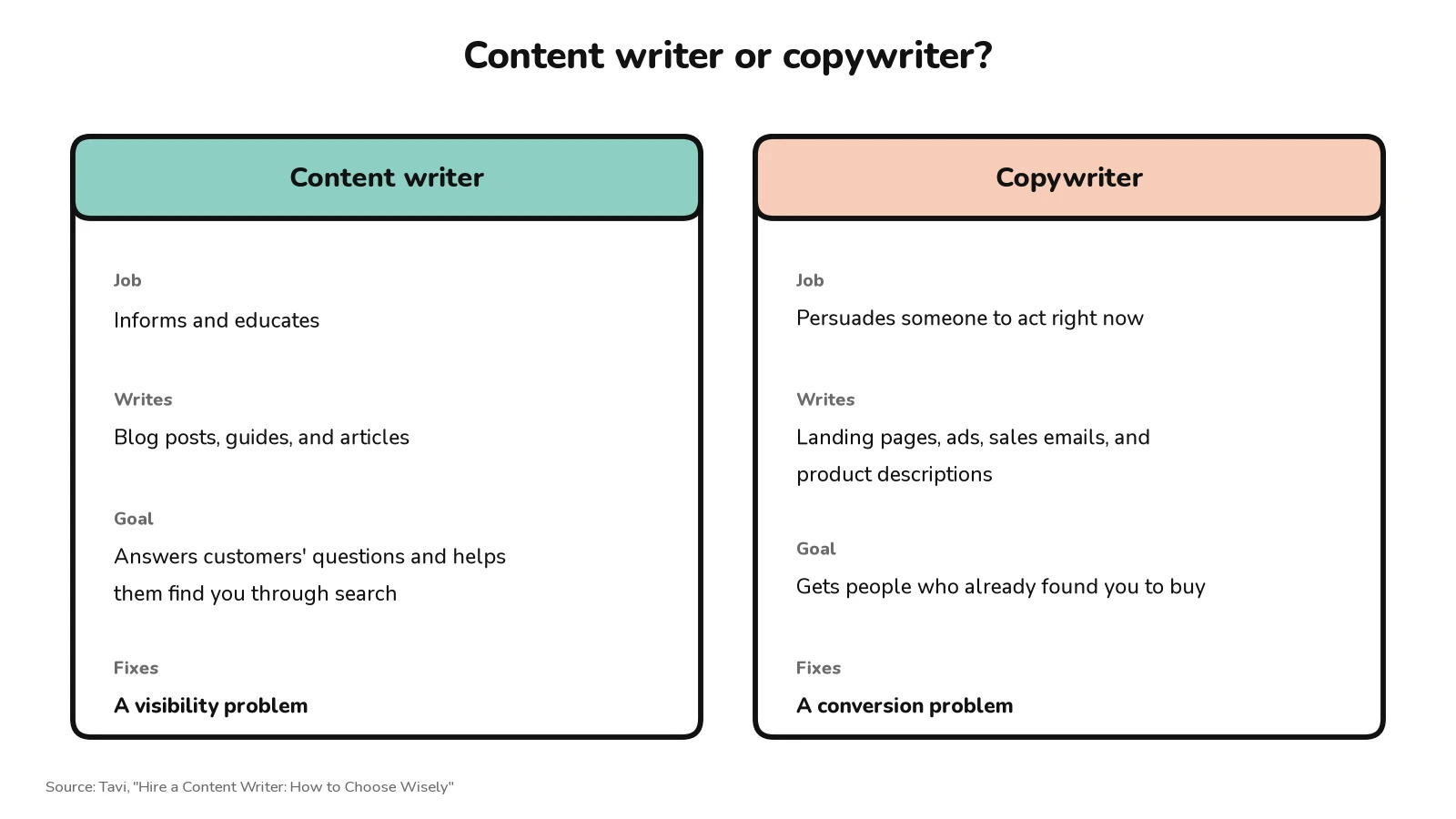
If the problem is visibility, the answer is content. If the problem is conversion (people find you but don't buy), it's probably copy.
What a good SEO content writer actually does
For SEO content, turning a topic into 1,500 words is one part of a bigger job. A strong SEO content writer usually handles:
- Keyword, intent, and competitor research: what customers search for, what already ranks, and the gaps.
- Structure: clear headings, short paragraphs, and a direct answer near the top.
- Your expertise: your stories, opinions, and methods, so the article says something other results don't.
- On-page SEO: titles, meta descriptions, and internal and outbound links.
- Fact-checking and editing, so every claim holds up and the piece reads like a person wrote it.
The expertise piece now matters most. In its guide to optimizing for generative AI features, Google says creating content that people find "unique, compelling, and useful" will likely influence your site's presence in generative AI search "in the long run more than any of the other suggestions in this guide." So the writer needs a way to get that unique material out of you.
Where to hire content writers: your four main options
When people search for where to hire content writers, they mostly find marketplaces, which are one of four main routes.
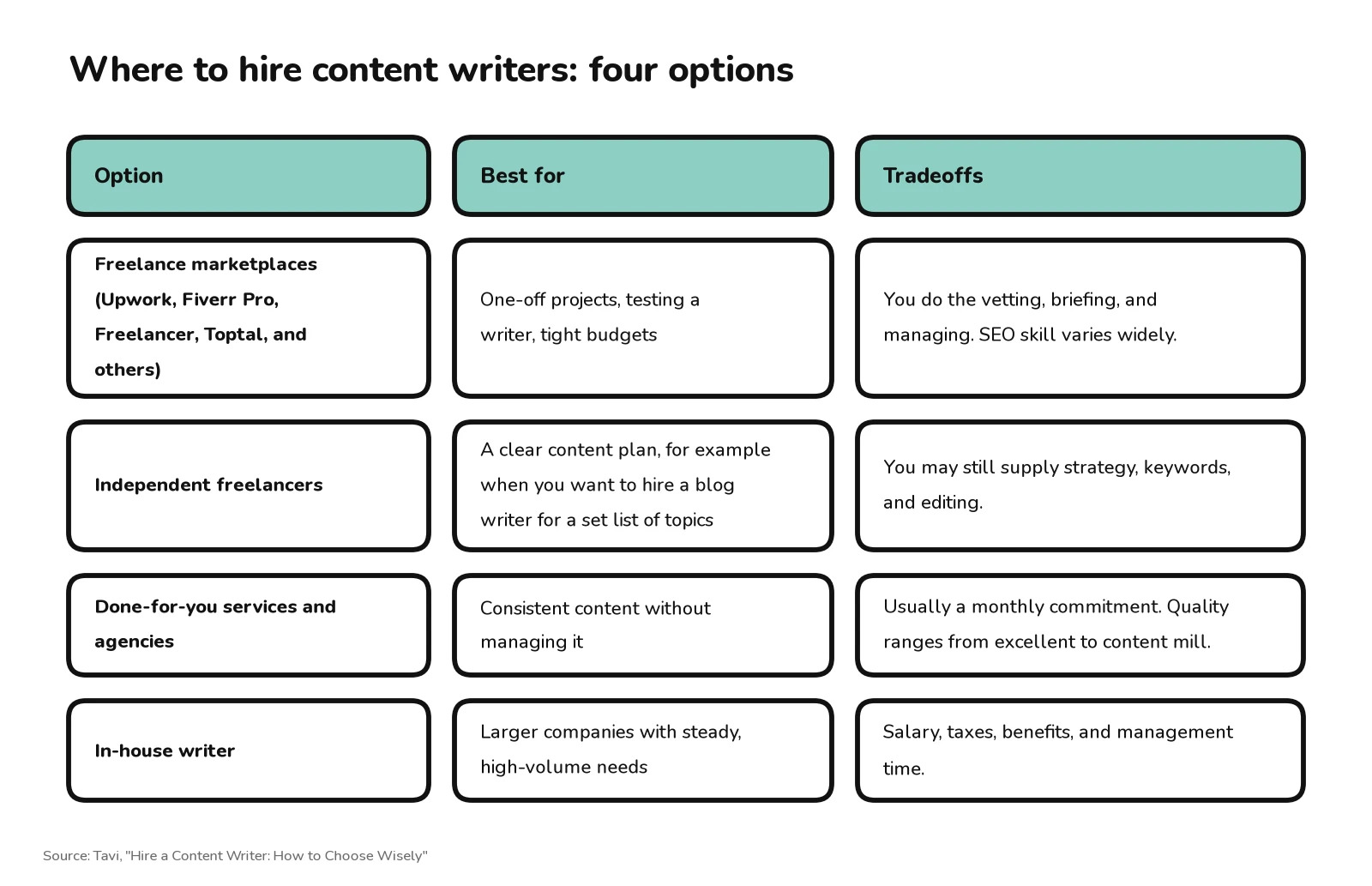
Freelance marketplaces
Marketplaces can be fast. Toptal's content writer page says you can hire "in about 48 hours," with a trial period of up to two weeks, and that fewer than 3% of applicants are accepted into its network.
The catch is that a marketplace gives you access, not strategy. The buyer still picks topics, writes the brief, checks the SEO, and edits the drafts.
Independent freelancers
A good freelance content writer fits well when the topics are already clear. As Freelancer.com's guide puts it, "If you already know what topics you want covered, a content writer is the right hire."
Done-for-you services and agencies
This is where businesses outsource content writing more fully. A content writing agency or done-for-you content writing service usually handles planning, research, drafting, editing, and reporting.
Quality varies, from specialists who interview clients to content mills that turn out generic articles in bulk, the kind of output Google's spam policies treat as scaled content abuse when it exists mainly to manipulate rankings. Google's helpful content guidance asks whether content is "mass-produced by or outsourced to a large number of creators," so that individual pages don't get much attention or care. That question makes a useful filter for any agency.
One done-for-you model: interview-based SEO blog posts, 2 to 5 articles a week, each edited by a human. See plans or book a free 30-minute call. [TIFFANY: confirm the 30-minute call is free]
In-house writers
An employee offers the most control and the biggest commitment. The IRS explains that for employees, you generally withhold income tax, Social Security, and Medicare and pay unemployment tax, while you generally don't withhold taxes for independent contractors. Benefits, software, and management time add to the cost.
How much does it cost to hire a content writer?
It depends on what you're buying. One quote for "a blog post" might cover a writer turning your outline into words. Another might include keyword research, an interview with you, fact-checking, on-page SEO, editing, and reporting.
What drives content writer cost
A few factors move the price most:
- Scope: writing only, or strategy, research, editing, and SEO too.
- Expertise: Toptal, for example, groups content writers into junior (up to 2 years), mid-level (3 to 5 years), and senior (6+ years) tiers.
- Research depth and length: a long, well-sourced guide takes far more time than a quick overview.
- Volume: ongoing plans often cost less per article than one-off projects.
Common pricing models
Content writer rates are usually quoted per word, per article, per hour, as a monthly retainer (common for agencies), or as a salary.
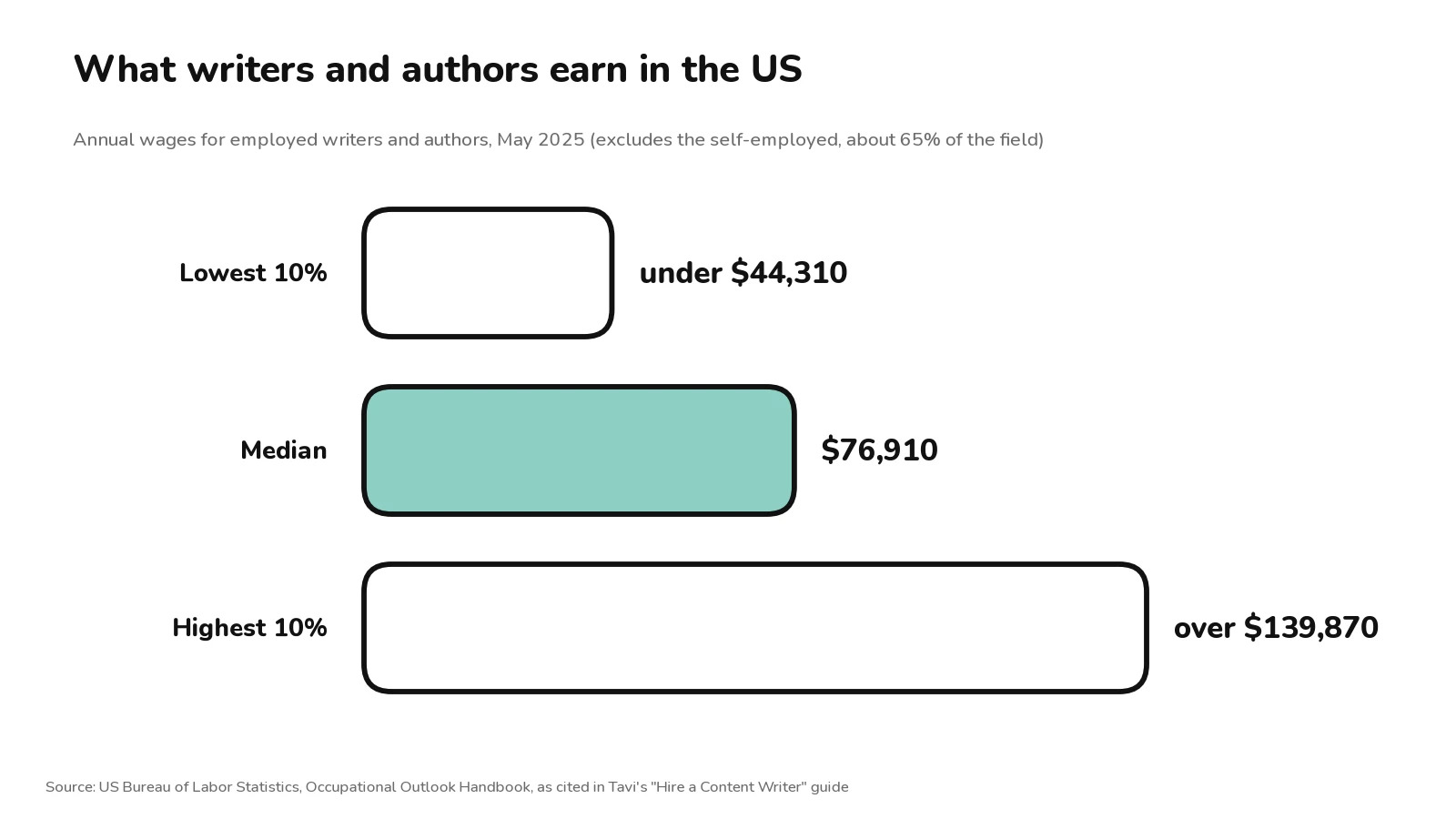
For employed writers, the US Bureau of Labor Statistics reports a median wage of $36.98 an hour ($76,910 a year) for writers and authors in May 2025. The lowest 10% earned under $44,310 a year and the highest 10% over $139,870. Those figures cover all kinds of writers and leave out self-employed writers, who make up about 65% of the field, so freelance rates can land well above or below them.
What a managed blog service costs
Tavi is a managed blog service that includes regular client interviews and a monthly SEO growth report. We charge $2,200 a month for about 8 articles (2 a week) or $3,000 a month for about 12 (3 a week). The main benefits here are experience, and dedication to you as a client. Client interviews that mine unique content are very valuable in terms of search visibility. Most freelancers won’t offer that.
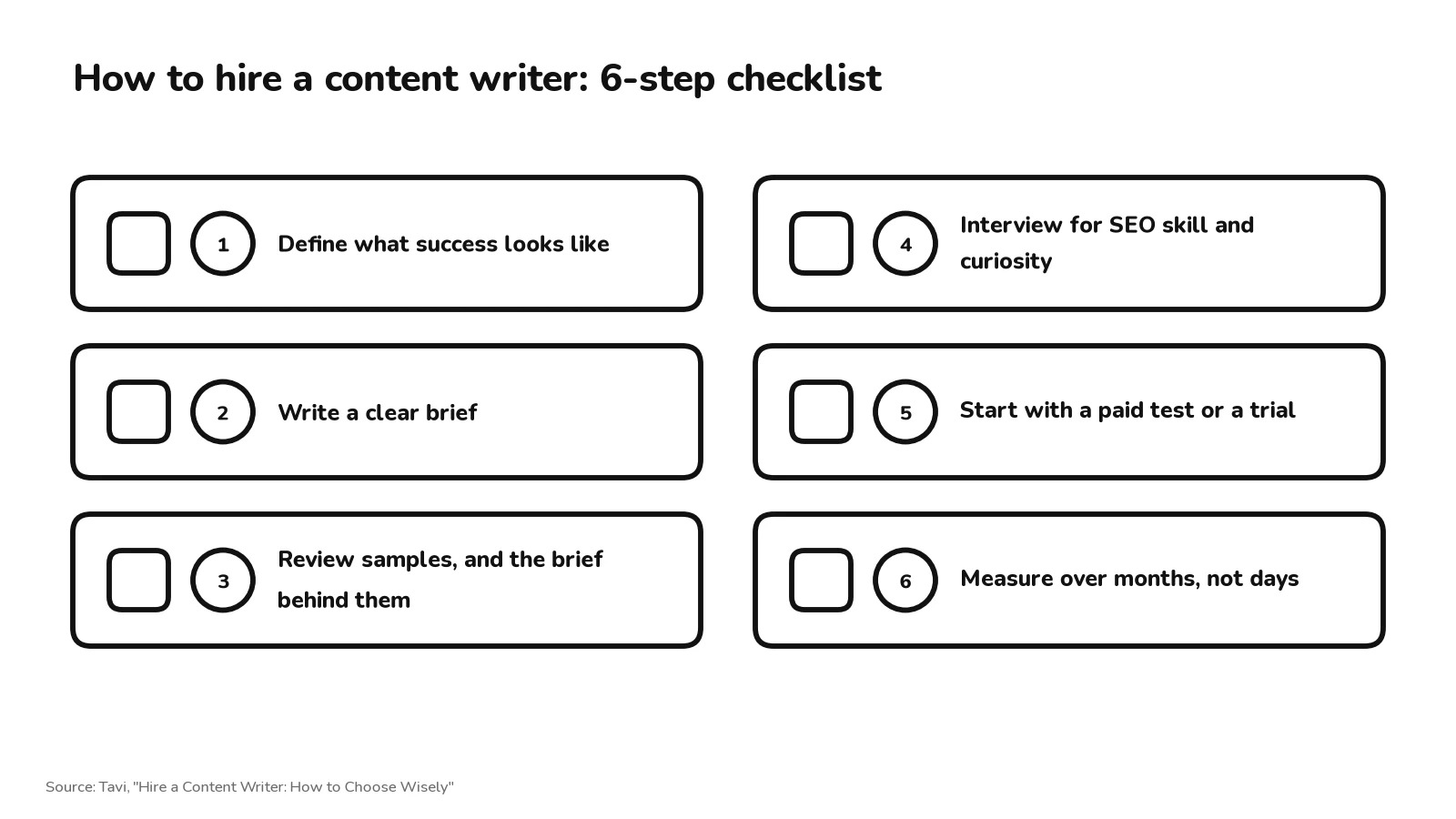
How to hire a content writer, step by step
Whichever route you choose, the hiring process looks roughly the same.
1. Define what success looks like
The goal comes before the word count. Hubstaff Talent's advice is to measure a writer against the reason you hired them, which is hard if the reason was never written down.
2. Write a clear brief
How much of the brief the writer handles depends on the route. A full-service writer or agency usually builds most of it, while a marketplace hire usually works from the buyer's brief. Either way, a short checklist covers the essentials:
- The goal: traffic, leads, or answering a common question
- The angle: opinions, stories, methods, or results competitors can't copy
- Must-avoid items: claims you can't make, competitors not to name
- The basics Freelancer.com lists: content type, word count, audience, tone, keywords, format, deadline, and revisions
3. Review samples, and the brief behind them
Samples show whether someone can write, but not always whether they can write for you. Freelancer.com suggests asking for samples along with the brief behind them, which shows what the writer was given and what they did with it.
4. Interview for SEO skill and curiosity
When you hire an SEO content writer, writing skill is only half the job. These questions, adapted from Freelancer.com, Toptal, and Google's "Do you need an SEO?," cover the other half:
- How do you research a topic when you're not an expert in it?
- How do you choose keywords and figure out what searchers want?
- How do you use AI, and where do humans take over?
- How do you get a client's expertise and stories into the article?
Their questions matter just as much. A good SEO, Google's guide says, "should ask questions about what makes your business unique, who your competitors are, how search results can help, and how your customers find you." The same goes for a content writer.
5. Start with a paid test or a trial
Toptal suggests reviewing a portfolio or giving "a short paid test assignment." For a sense of timing, Freelancer.com says a standard blog post of 1,000 to 1,500 words usually takes a freelance writer "two to four business days from brief to final draft, including research and one round of revisions."
Written agreements for content work usually spell out:
- What each article includes (research, SEO, images, publishing)
- Revision rounds and turnaround time
- Who owns the finished work
- How the writer uses AI
- How either side can end the arrangement
6. Measure over months, not days
Google's SEO Starter Guide notes that some changes can take effect in a few hours, while others "could take several months." That's why a new writer's first few months say more than the first few weeks, once impressions, clicks, and leads in Search Console and your analytics have had time to move.
Red flags to watch for
A few warning signs stand out.
- Guaranteed rankings. Google says it plainly: "No one can guarantee a #1 ranking on Google" (Google Search Central).
- Huge volume at a tiny price, with no questions about your business. Google's spam policies describe scaled content abuse as generating many pages "for the primary purpose of manipulating search rankings and not helping users."
- Vague answers about AI. AI use isn't a problem on its own. Hiding it, or skipping the human edit, is.
- Secrecy about the process. Google's guide warns, "Be careful if a company is secretive or won't clearly explain what they intend to do."
Is AI replacing content writers?
It's a common question for anyone hiring a writer now. The short answer is no for writers who bring something a tool can't, though AI is changing the field: the BLS projects little or no job growth for writers and authors through 2035 and expects AI to "dampen demand" for them. What AI replaces first is low-value content, the generic material any tool can produce.
AI tools help with research, outlines, and first drafts, but they can't understand a business on their own: the story behind its best customer win, or why it does things differently from the shop down the street.
Google draws the same line. Its guide to generative AI features calls generic material "commodity content" that's often "based on common knowledge, which could originate from anyone." Its AI content guidance says AI "can be particularly useful when researching a topic," but warns against using it "to generate many pages without adding value for users."
So "Do you use AI?" matters less than "What do you add that AI can't?" Good answers mention interviews, fact-checking, and a human edit. Tavi’s founder wrote a post called The Death of the Human Writer which goes deeper into this discussion.
How a good content service works
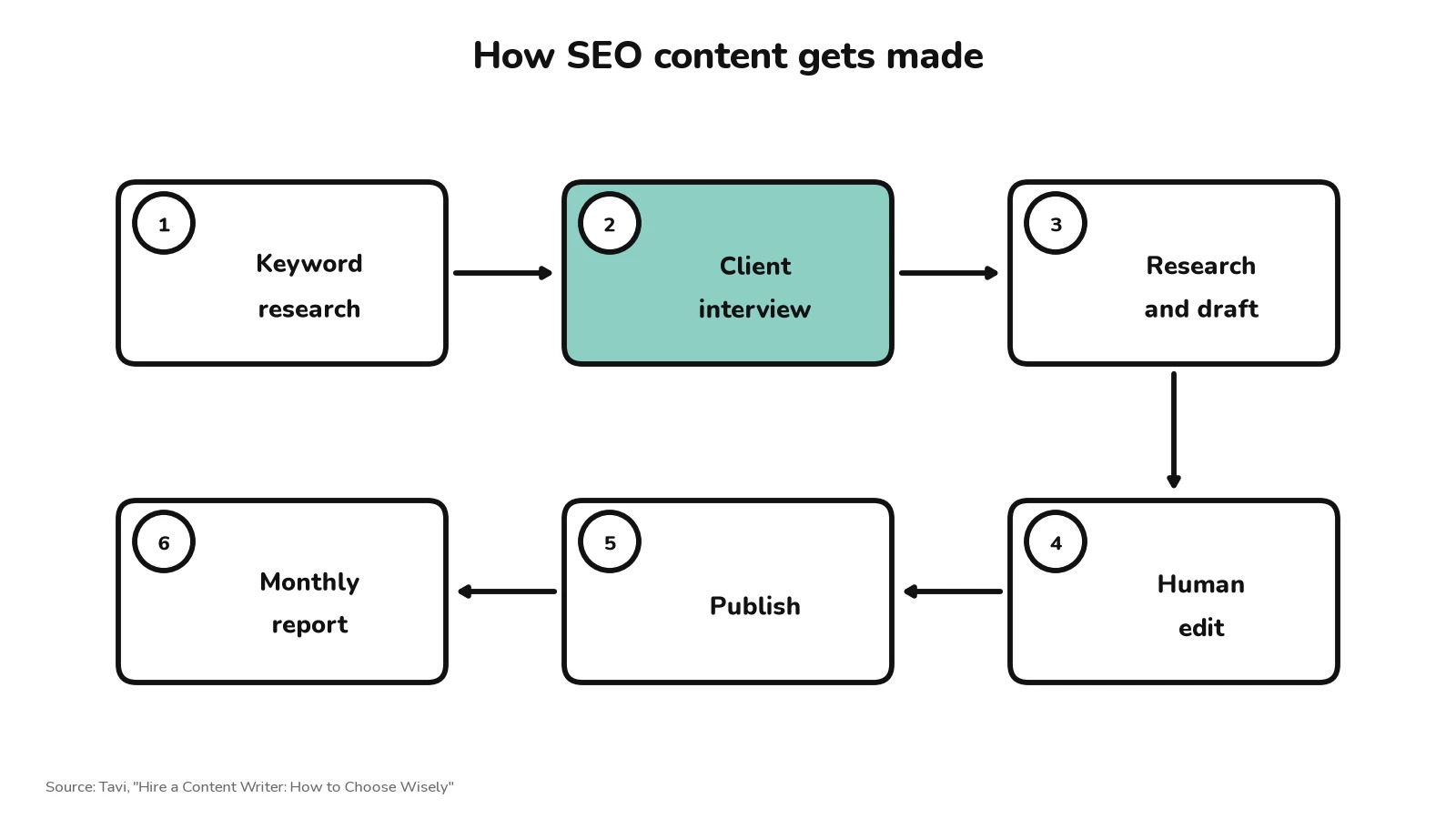
A good content service works in a clear order: an interview, then AI research and a first draft, then a human edit.
The interview comes first because short, regular conversations pull out stories and examples no competitor can copy. One approach then uses a system of AI prompts and AI tools, nicknamed "helpers," for research and a search-optimized first draft, which is only a starting point. A human then edits every final draft so it reads well, holds up to a fact check, and draws on the client's expertise.
Around that core, the first few months usually include:
- Onboarding. The writer learns your business, audience, competitors, and goals.
- A content plan. Topics and keywords mapped to what customers search for.
- Your review. You check facts, tone, and anything only you would know.
- Publishing and reporting. Articles go live on a steady schedule, with regular updates on how they perform.
Existing blog posts usually come up early too, since a quick audit shows which to keep, update, or rewrite.
Final thoughts: hire for visibility, not just words
Hiring a content writer is a decision about visibility and growth. If the business is good and the website is ready, content is how that cute little clothing store moves onto a street where people actually walk.
The right writer learns the business, pulls out the expertise only the owner has, and turns it into articles that people and search engines trust.
A second opinion on the timing takes one short conversation. Book a free 30-minute call. Someone out there is searching for exactly what you offer. The right content helps them find you.
Frequently asked questions
How much does it cost to hire a content writer?
It depends on what's included. A writer who only writes usually costs less per article than a service that also handles research, interviews, editing, SEO, and reporting. Freelancers often charge per word, per article, or per hour, while agencies usually charge a monthly retainer. One example appears in what a managed blog service costs above.
How much should a content writer charge per word?
There's no single right rate. Per-word prices vary with experience, niche, and how much research, SEO, and editing are included. A low rate for writing alone can cost more if the business still plans, edits, and fact-checks every post. What's included per article tells you more than the price per word.
How much is a content writer paid?
It varies by experience, specialty, and employment type. The BLS reports a median annual wage of $76,910 for writers and authors as of May 2025. An employer's total cost is higher once taxes, benefits, and tools are included, and the figure leaves out self-employed writers, about 65% of the field.
Should you hire a freelancer or an agency?
A freelance content writer is a self-employed writer hired per project or on a retainer. A freelancer tends to fit best when a business already has a content plan, keywords, and time to edit. An agency or done-for-you service fits better when strategy, writing, editing, and reporting should all be handled.
Who owns the content after you hire a writer?
Without a written agreement, a freelance writer usually owns it. The U.S. Copyright Office explains that the person who creates a work is ordinarily its author. Work an employee creates as part of the job is the exception: it counts as a "work made for hire" and belongs to the employer. A commissioned piece from a freelancer only counts as a work made for hire in certain categories and with a written agreement signed by both sides. That's why ownership belongs in the agreement before any work starts. A clear agreement covers who owns the finished articles, when ownership transfers (for example, on payment), and whether the writer can show the work in a portfolio.