October 15, 2026
Tavi
SEO Blog Writing: 10 Steps To Showing Up In More Searches
What are your customers searching for? It's a question every business owner needs to be asking. But once you know that you provide the exact answer your customers are looking for, there's one more step to take: making sure they find you first, instead of your competitors.
You might have the best product or service. But it won't matter if your customers can't find you, or they find some other business instead of yours.
SEO blog writing is the practice of creating blog posts that fully answer a searcher's question, so search engines rank them and AI answer engines cite them. It combines keyword research, genuinely helpful writing based on real experience, and on-page optimization.
But there's one part most guides skip.
A perfectly optimized article can still go nowhere. A technically flawless post, whether AI or a human wrote it, is incomplete unless it offers something readers can't find anywhere else. We refer to this as "unique content" and it's everything when writing blog posts in 2026.
Several of the page-one guides come from companies that sell SEO tools, like Semrush, Backlinko (owned by Semrush since 2022), and Yoast. Their advice is solid, and it’s referenced below where it's the clearest source.What no software can supply is a business owner’s own experiences, opinions, and unique point of view.
Key Takeaways
- Interviews with the business owner surface stories and opinions nobody else has. Without something original like that, blog posts won’t rank as well.
- The searcher comes first, the keyword second.
- What already ranks tells you the format, length, and sections searchers expect.
- The basics still matter: one primary keyword, clear headings, short paragraphs, good links, and a strong title.
- AI is a great helper, but it needs a human strategist and editor.
- Refreshing old posts can be faster than writing new ones.
Prefer to skip the work? Tavi writes interview-based SEO blog posts for businesses, 2 to 5 articles a week, edited by humans. See plans or book a call.
Why SEO blog writing matters more in the age of AI answers
Search engines and AI tools now answer many generic questions on their own, so posts with something original have a much better shot at winning the click or the citation.
Good SEO writing combines genuinely helpful content with smart optimization. A post that's all optimization loses readers, and a beautifully written post that nobody can find doesn't reach anyone. Google's guidance on creating helpful, reliable, people-first content says its ranking systems prioritize content made to benefit people, not content made to manipulate rankings.
Google Search works by crawling the web to discover pages, indexing them to understand each one, and serving the most relevant results when someone searches. SEO helps Google understand content that deserves to be found.
Where people look for answers has shifted, too. Many now also ask ChatGPT, Claude, Perplexity, and Google's AI Overviews for answers.
A Pew Research Center analysis found that users who saw an AI summary clicked a traditional search result in 8% of visits, versus 15% for users who didn't see one.
For your business, here’s the main takeaway: generic answers get summarized, while unique answers get cited as sources. A post built on experience only your business has becomes a source worth pointing to.
Google's own documentation on AI features and your website says no special tricks are required to appear in AI Overviews or AI Mode. The same fundamentals apply, so good SEO blog writing still wins. The bar for "helpful" has simply gone up.
Is SEO blog writing content writing or copywriting?
Short answer: SEO blog writing is content writing, although it borrows a few important skills from copywriting.
Copywriting is the craft of writing persuasively to sell a product or service. In the pilot of Mad Men, Don Draper wins the Lucky Strike account by taking the focus off the Surgeon General’s warning and putting it on something positive and benign: “Lucky Strike: It's Toasted." The scene is fiction, but the slogan isn't. The American Tobacco Company began using "It's Toasted" for Lucky Strike in 1917, decades before the show is set. A good copywriter finds the thing that makes people feel good about buying the product. That's persuasion built on understanding people.
Content writing informs, and it relies on good SEO techniques to reach people. It persuades differently, by giving searchers everything they need on the website of a business that can help them. The two overlap in your title, meta description, and calls to action, which all need to persuade someone to click.
We break down the differences in our guide to [INTERNAL LINK: content writing vs copywriting].
How to write an SEO-friendly blog post: our 10-step process
Here's the process we follow for every article, whether it's a client's first blog post or their five hundredth.
Step 1: Start with the customer and the keyword
Every post targets one primary keyword, chosen from the words your customers actually use.
But we don't start in a keyword tool. We start with a question: what is our client's customer actually typing into the search bar? Some searchers are ready to buy. Others are just learning. Both matter.
Google's SEO Starter Guide gives a nice example: some people search for "charcuterie," others for "cheese board." Same need, different words. We weigh each candidate keyword against three criteria:
Newer sites usually have better luck with longer, lower-difficulty phrases. Good free starting points include Google autocomplete, People Also Ask, Google Search Console, and Google Keyword Planner.
Step 2: Study the search results before you write a word
The pages that already rank show the format, length, and depth searchers expect, so we read them before writing anything. Most people skip this step, yet it saves the most rewriting. We search the keyword, analyze the top pages, and note three things:
Those notes reveal the search intent, which usually falls into one of four types:
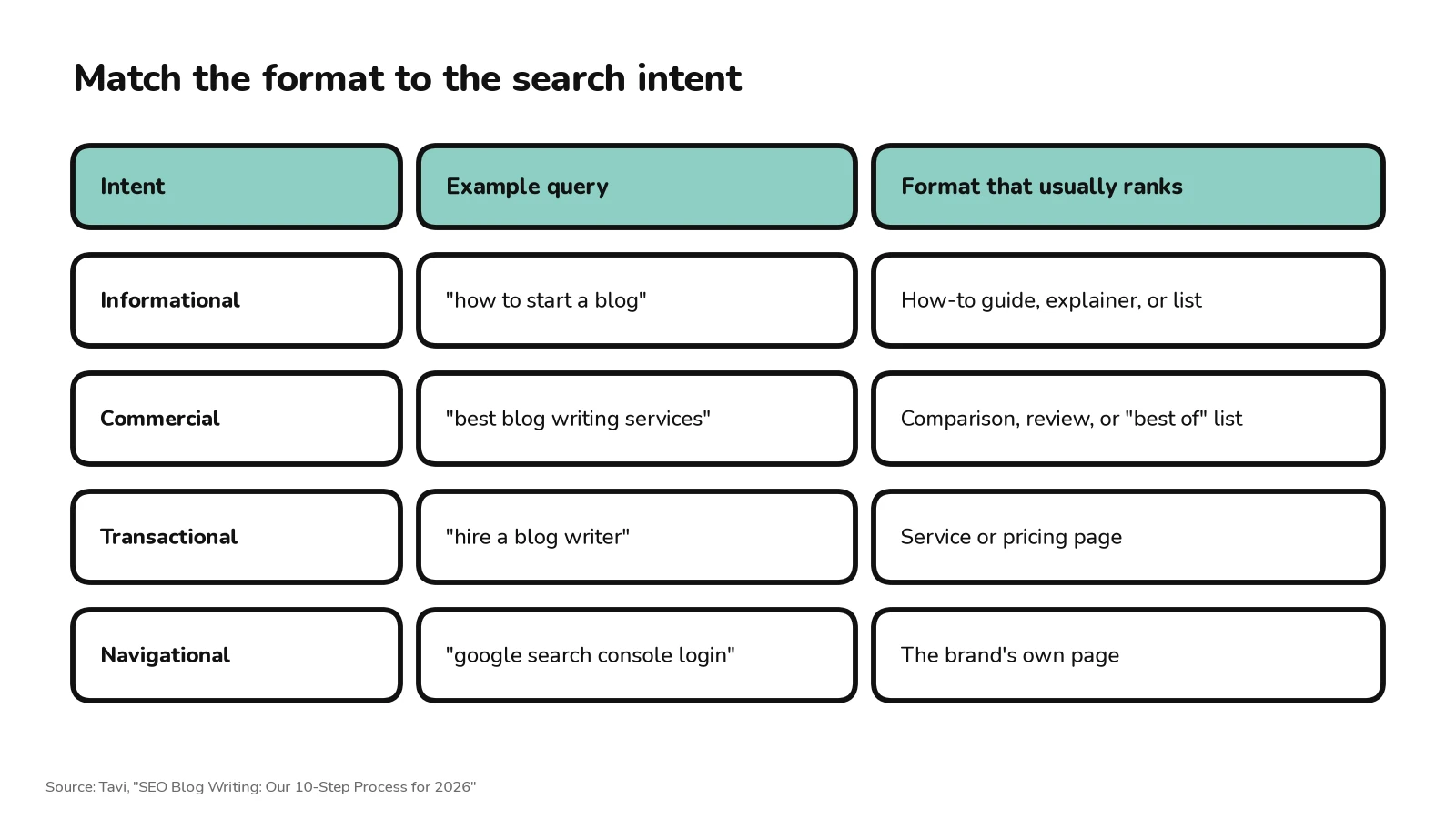
That's also the honest answer for anyone wondering about the best blog format for SEO: it's whatever matches the intent. If every top result is a list, a long essay probably won't break in.
Step 3: Build a keyword map
One primary keyword doesn't mean one keyword only. We map 5 to 10 secondary keywords: synonyms, subtopics, and long-tail questions. For this guide, that meant terms like "seo content writing," "seo-friendly blog," "blog post seo checklist," and "how to write seo-friendly blog."
Each one might become a subheading, an FAQ question, or a natural phrase in a paragraph.
Keyword stuffing might be tempting, but it backfires. Google's spam policies call it out by name, including "repeating the same words or phrases so often that it sounds unnatural." The primary keyword should fit naturally (title, intro, a subheading or two, the conclusion) and let variations do the rest. The read-aloud test is the real rule. If you read it out loud and it sounds natural, that’s good content.
Step 4: Interview for experience nobody else has
This is the step that sets Tavi’s process apart.
Before we write, we interview our clients to mine their unique experiences, opinions, and differentiators. Those conversations shape the angle, the examples, and the point of view in the final article.
Google requires E-E-A-T: experience, expertise, authoritativeness, and trustworthiness. It isn't a ranking factor by itself, but Google's systems look for content that shows it. Its helpful content guidance asks whether your content "clearly demonstrate[s] first-hand expertise and a depth of knowledge." It also asks for "original information, reporting, research, or analysis."
Client interviews take this a step further, whittling down the the experience and trust to a specific person or business, and showing how this person or business offers something different from everyone else.
Questions that draw out that kind of experience:
Articles written from a unique perspective get more citations from AI.
Step 5: Outline with clear headings
A good outline gives every section a job before anyone writes a paragraph. Ours include:
Outlining first keeps subtopics in logical order and makes AI helpers far more accurate. The number of sections comes from what we saw in Step 2, and we go deeper wherever the client has something unique to offer.
One more habit: answer first. Each section opens with a direct answer of one or two sentences. Yoast notes that concise answers up top are easier for AI models to extract. Readers like it, too.
Step 6: Draft with AI helpers, never on autopilot
We use AI to research and draft faster, but it never replaces the client's experience.
At Tavi, a system of AI prompts and "helpers" creates a researched, search-optimized first draft. But it's only a starting point.
Google is clear about this balance. Its guidance on generative AI content says AI "can be particularly useful when researching a topic, and to add structure to original content." It also warns that mass-producing pages without adding value may count as scaled content abuse.
Our non-negotiable drafting rules:
Step 7: Edit like a human, for humans
Editing is where a draft becomes a real article, and we edit every final draft by hand.
Our edit looks for:
Big SEO publishers rely on human editors, too. Semrush says every article it publishes goes through at least one round of editorial review. In other words, even a company that sells AI writing software still puts people between the draft and the publish button.
Step 8: Optimize the on-page elements
Once the writing is strong, we polish the technical details that help search engines read the page. That polish turns a good draft into an SEO optimized blog post.
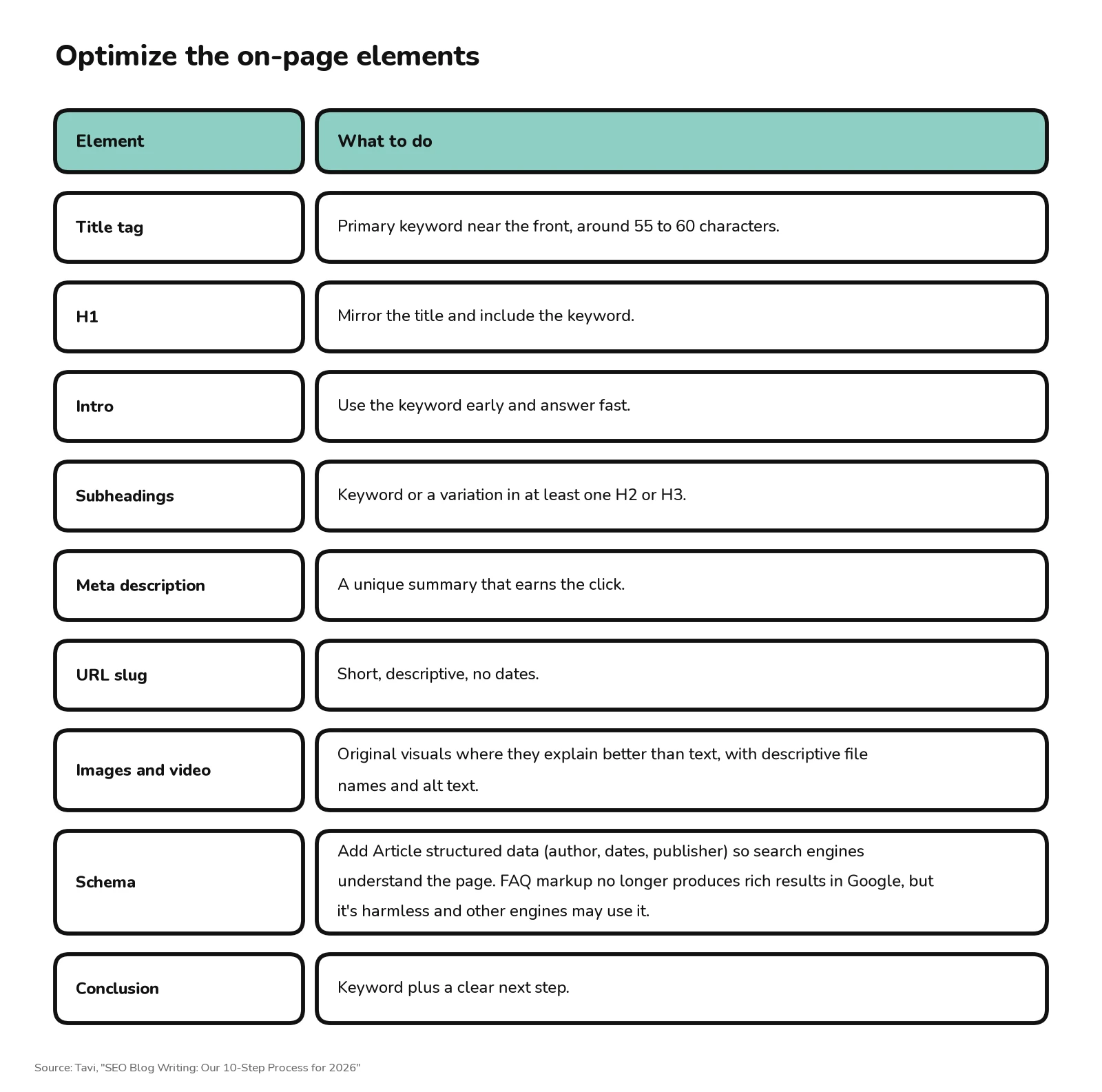
Google primarily builds snippets from page content, but it may use your meta description when it describes the page better, which is why every page we publish gets a unique one. For images, Google's SEO Starter Guide recommends alt text that explains how the image relates to your content.
Titles are where copywriting does the most work. A few formulas that tend to work:
Step 9: Link the post into your content hub
Every new post links to related pages on the site, and older posts link back to it. Internal links help readers and search engines see how your pages connect. Backlinko suggests 5 to 10 links out to older posts and 5 to 10 back. We add only links that help the reader.
Descriptive anchor text matters here. "Our guide to refreshing old blog posts" tells a reader far more than "click here" does. Google's SEO Starter Guide says good anchor text tells users and Google what the linked page contains.
Links to authoritative sources help, too, because readers can see where the facts come from. We organize all of this around pillar pages and spokes: a pillar like this guide covers a broad topic, and spokes go deep on narrower questions and link back.
Step 10: Publish, measure, and refresh
Hitting publish is the middle of the SEO blog writing process, not the end.
Measuring starts in Google Search Console. Its Performance report shows which queries and pages earn clicks, and how your position changes over time.
Results also take time. Google's SEO Starter Guide says some changes take effect in hours while others can take several months.
After that, we revisit each post regularly with fresh stats and new client insights, always keeping our clients in the loop with honest, monthly reporting.
How long should a blog post be for SEO?
There's no ideal word count. Google says length alone doesn't affect rankings, so match the depth of the pages that already rank and stop when the question is fully answered.
Its SEO Starter Guide states that content length alone doesn't matter for ranking. Its helpful content guidance even lists "writing to a particular word count" as a warning sign.
Still, length is a useful clue about what searchers expect, which is why we compare against the pages that already rank.
We set length by weighing three things:
For pillar articles like this one, we plan for around 3,000 words. Narrower spoke articles are often shorter.
Can AI write SEO blog posts? Where AI helps and where humans win
AI can research, outline, and draft, but it still needs a human edit and human experience to produce a post worth ranking.
"Can't I just use an AI SEO blog writer instead of paying a person?" Business owners ask us this constantly, and it's a fair question. Our honest answer: AI is very useful, but humans still do the strategy, the interviews, and the edit.

Skipping the human part risks more than bland writing. Google's spam policies describe scaled content abuse as creating "large amounts of unoriginal content that provides little to no value to users, no matter how it's created."
That last phrase, no matter how it's created, is the part people miss. Google's problem is with low-value content, whether a person or a machine produced it. Interesting, right? You, as a human being, can still write bad content without any help from AI.
Google also suggests asking whether it's clear how automation was used. That's one reason we're open about using AI, and why we never let it impersonate our clients. We write from a “nameless expert” perspective. In addition to the blogs we create for them, we encourage clients to write their own posts, adding their byline to show that the post was written 100% by a human. It’s not necessary, but it adds to that trust factor.
I wrote more about this in The Death of the Human Writer. See where AI fits in our workflow in how Tavi uses AI.
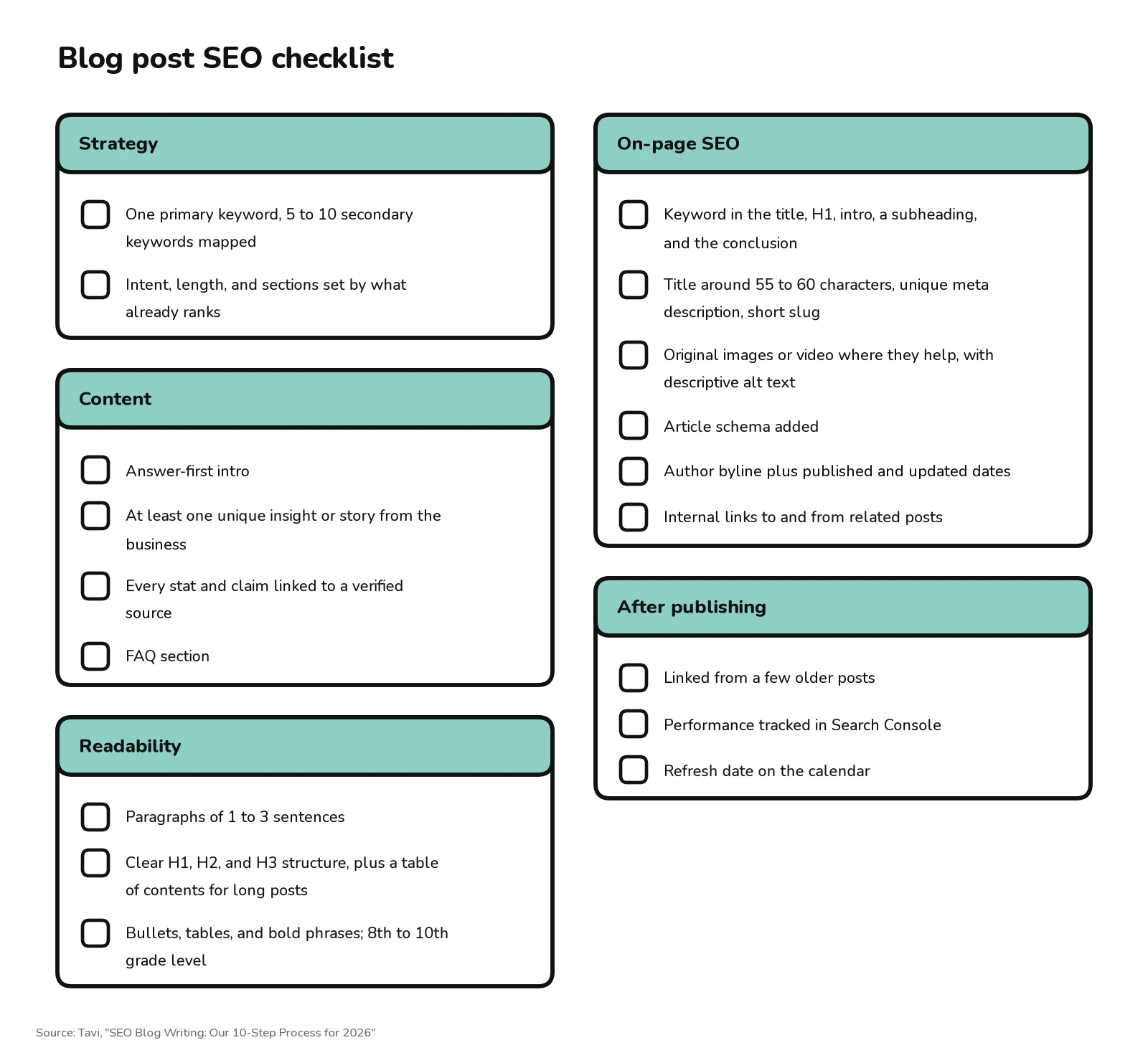
Blog post SEO checklist (free to copy)
Here's everything a post needs before it goes live, in checklist form.
Don't have time to do this yourself?
If you'd rather run your business than learn this process, we understand!
Most business owners don't have time to learn all of this. AI makes it faster, but using AI the right way, without producing generic, low-value content, is its own skill.
Imagine a cute little clothing store in a terrible location. The products are great, but nobody walks down that street. Eventually the business fails. This is an IRL example of what happens to your website when it isn’t showing up in search and citations. Plenty of online businesses have a solid brand, solid website, solid products, but still struggle to get leads simply because the people searching for what they sell are finding their competitors instead.
That's when it makes sense to hire an SEO blog writer or invest in professional SEO blog writing services. Content writing that's optimized for search brings customers to your digital doorstep.
Great SEO blog writing is still human
The fundamentals of SEO blog writing haven't changed. It still comes down to one keyword, a close look at what ranks, a clear outline, writing for real people, and care with the details.
What has changed is the bar. With AI summarizing the generic stuff, original experience is what gives a post its best chance of being found and cited. That's why we interview and edit by hand.
For anyone doing this in-house, one well-researched post is the best place to start, and a hub can grow around it from there.
And if you'd rather spend your evenings running your business than writing blog posts, let's talk. Book a free 30-minute call. Someone out there is searching for exactly what you offer. We'll help them find you.
Frequently Asked Questions
What is SEO blog writing?
SEO blog writing is blog writing with a search strategy behind it. Every post targets a real question your customers ask and is built to be found, read, and cited. It's closely related to SEO content writing, which is the broader category covering guides and other informational pages, with blog posts as one slice of that work.
How do I write an SEO-friendly blog post?
Start with one primary keyword, supported by roughly 5 to 10 secondary or long-tail keywords. From there, study what already ranks, outline with clear headings, write answer-first sections, and optimize the on-page elements. Most importantly, add something competitors don't have, like a real story, insight, or piece of experience.
What is the best length and format for an SEO blog post?
The best length is long enough to fully answer the question and no longer, since Google says there's no preferred word count. The best format is whatever matches what already ranks for your keyword. For most how-to searches, that's a scannable guide with an answer-first intro, question-style subheadings, short paragraphs, and an FAQ.
Can ChatGPT write SEO blog posts?
ChatGPT and other AI tools can help with research, outlines, and first drafts. On their own, though, they tend to produce generic content that looks like everything else that already ranks. The best results pair AI with human strategy, real experience, and a careful edit.
Is SEO writing still worth it with AI Overviews?
Yes, as long as your posts offer something original. AI Overviews summarize generic answers, but they also cite sources. Experience-based posts with original insight are the ones worth citing, which makes them more valuable, not less.
How much does SEO blog writing cost?
It depends on how many posts you need, how in-depth they are, and how much strategy, research, and editing is included. Some freelance writers charge per word or per post, while agencies and done-for-you services more often charge a monthly fee that bundles keyword research, interviews, and reporting. Be wary of low price tags, because you're often risking paying for content that Google will flag.
How often should I publish, and should I update old posts?
Consistency matters more than any single number, so the right pace is whatever you can keep up without quality slipping. Two to five articles a week is pretty standard. Refreshing older posts that already earn impressions is a quick win, while new posts expand your keyword reach, and an audit shows where to start.